This is too much info before we’ve done any classes or workshops. ArcherFrequently Asked Questions
2
3
6
7
8
9
10
What does the Hawai’i Institute of Rainwater do?
1
What are the benefits of rainwater harvesting?
What role does the government play in overseeing the water quality in my catchment system?
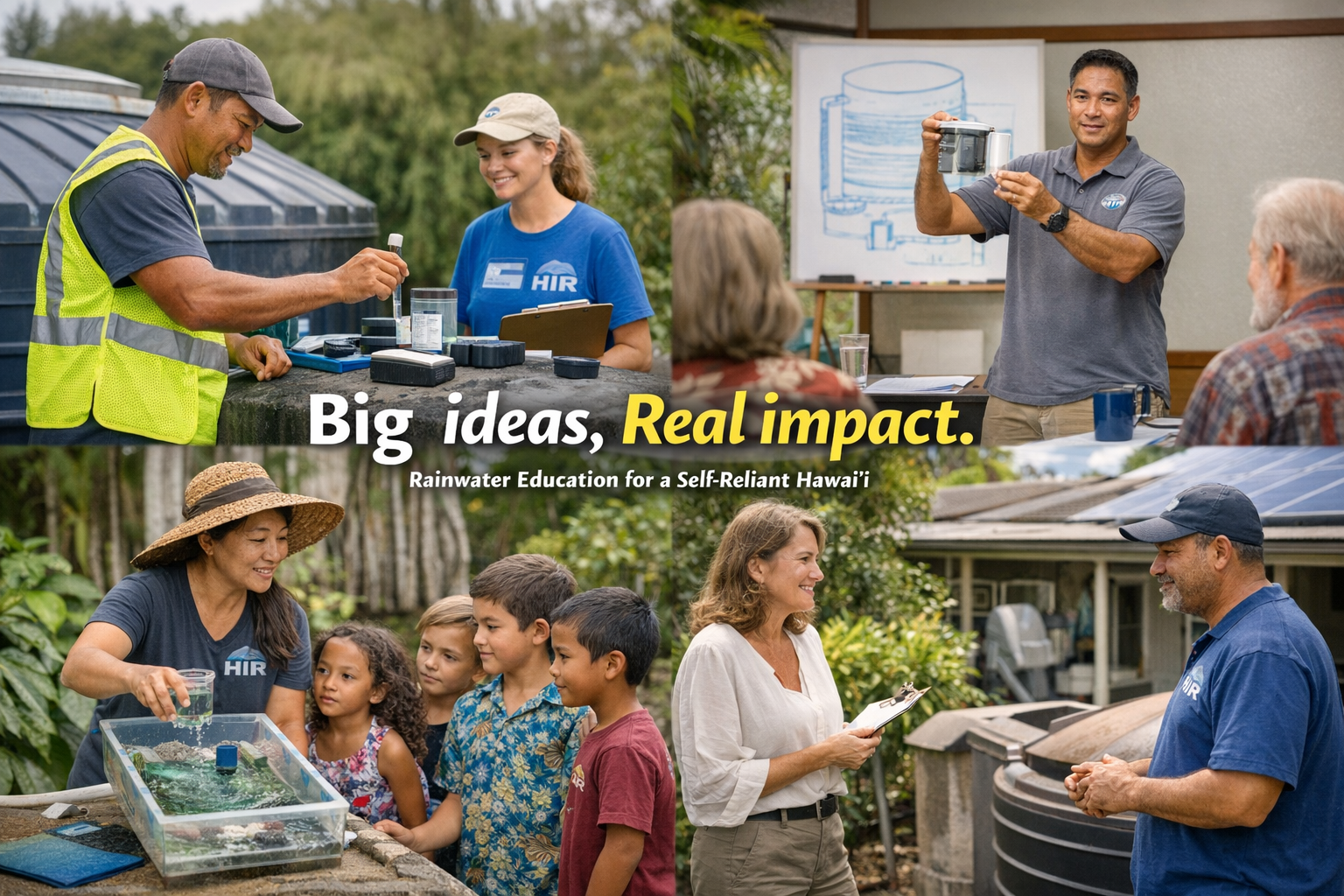
The Hawai’i Institute of Rainwater delivers rainwater catchment education, standards, and community support so Hawai‘i’s catchment households can confidently steward their water as self-reliant Rainwater Harvesters. In this way, users are actively engaging with their water system, its uses and long-term applications.
For many it is not a choice. For thousands of Hawai‘i households, rainwater catchment is the primary household water supply. Rainwater harvest allows residents without access to municipal water to harvest water for drinking, bathing, irrigation and to sustain other household needs. In Hawai‘i, there is no state or county agency regulating residential catchment systems. The responsibility rests entirely with the owner/user.
What is the number one problem that is often overlooked by rainwater harvesters in Hawai’i?
4
Managing pH Is Essential to Protect Your Water and Your Health
All rainwater is corrosive. Raising the pH of stored rainwater is a critical step in reducing corrosion and metal leaching. A pH of 7.0 is considered neutral. The ideal range for household water falls between 6.5 and 8.5, with a strong recommendation to maintain pH above 6.5 to reduce corrosion and metal leaching—particularly in systems with metal roofing, pipes, or fittings. Drinking water at a pH level of 6.5 or greater is ideal according to the Centers for Disease Control and Prevention. In Hawai’i, a pH of 5.6 or less is considered common. [need citations.]
Raising the pH of stored rainwater is a critical step in reducing corrosion and metal leaching. pH balancing can be achieved by introducing alkalizing minerals such as baking soda (sodium bicarbonate), granulated calcium carbonate (calcite), or sodium carbonate (soda ash). Among these options, baking soda is most commonly used due to its availability, affordability, and predictable performance. Baking soda acts as a safe neutralizer, allowing pH adjustment without the risk of excessive elevation. However, as noted by the University of Hawai‘i College of Tropical Agriculture and Human Resources, determining the correct dosage is not one-size-fits-all. Each catchment system is influenced by variables such as rainfall patterns, tank volume, roof materials, and existing water chemistry.
What makes rainwater harvesting in Hawai'i so unique?
5
What other risks are associated with catching rainwater?
What should I do to evaluate the water quality and infrastructure of my catchment system?
Is an ultraviolet filter (UV) enough to protect the water in my system?
Rainwater Harvesting empowers self-reliance—especially here in Hawai‘i, a remote island chain in the middle of the Pacific Ocean, built on five volcanoes, surrounded by the Ring of Fire.
Acid rain is a real and recurring threat to rainwater safety in Hawai‘i. While globally linked to industrial emissions, here on the islands, acid rain is largely driven by volcanic activity—specifically, sulfur dioxide (SO₂) from Kīlauea. When SO₂ combines with atmospheric moisture, it forms dilute sulfuric acid that falls as acid rain, often with a pH below 5.6. According to the University of Hawai‘i’s College of Tropical Agriculture and Human Resources, Kīlauea emits an estimated 350 metric tons of SO₂ daily during quiet periods and up to 1,850 metric tons during eruptions. Acid rain accelerates corrosion and leaching from rooftops, posing significant risks to your water quality if untreated.
Acid rain doesn’t just affect your tank—it attacks your plumbing. Copper pipes are especially vulnerable, and the impact is intensified when transporting hot water. Even before copper reaches unsafe levels, leaching can leave blue-green stains on porcelain and fiberglass sinks and tubs. Iron leaves behind brown stains, while lead—though toxic—is less likely to discolor surfaces, making it harder to detect without testing. Fortunately, the University of Hawai‘i offers subsidized water testing services.
Acid rain in catchment systems has no natural buffer—just your roof and tank. Unlike groundwater, rainwater collected from rooftops doesn’t pass through soil or rock to neutralize its acidity. In Hawai‘i, areas downwind of volcanic emissions—especially Kā‘ū and South Kona—frequently record rainwater pH levels as low as 4. This level of acidity accelerates corrosion, degrades system components, and increases the risk of metal leaching into your water supply. If you’re not testing and treating your water, you’re taking a chance with every drop.
How do I maintain my catchment system?
Is it safe to raise the pH of the water in my tank with baking soda if there is already bleach and chlorinated water in the the system?
In Hawai‘i, the safety of your rainwater is your responsibility. For households on rainwater catchment, you are the water department. There are no government agencies regulating individual catchment systems. There is no government oversight, routine monitoring, or required maintenance program. That responsibility belongs to the homeowner or user. This makes it essential for homeowners and users to fully understand both the benefits and the risks. If you're relying on rainwater for daily use, you must be equipped with the knowledge to manage your system properly and protect the health of your household and guests. Safe water doesn’t happen by accident—it’s the result of informed, proactive stewardship.
A properly designed rainwater harvesting system must be easy to use—and maintained without compromise. Routine maintenance isn’t optional; it’s essential to ensuring clean, reliable water. Failure to maintain your system can lead to unsafe water, lower storage capacity, bacterial contamination, and serious health risks to users.
First flush diversion removes contaminants at the source—protecting water quality before it reaches the tank. first flush of rainwater often carries bacteria from decomposed insects, bird and animal droppings, tannic acids, sediments, heavy metals, and chemical residues. A properly sized First Flush Water Diverter is essential to protecting water quality. By diverting this initial runoff away from storage, the system ensures cleaner water enters the tank.It prevents the initial runoff from the roof—where contaminants accumulate—from entering the tank, reducing both contamination risk and tank maintenance.
Every component—from the roof to the faucet—must be part of a clear, consistent maintenance plan. When systems are neglected, water quality suffers. When they’re maintained, water security thrives. HIOR recommends weekly and monthly monitoring of residential catchment systems. [can we add a plan for people to download here?]
Yes it is safe. Bleach and baking soda are both bases and they have no interactions when they are introduced together. It is safe to add bleach and baking soda at the same time. You are not going to create any chemical reactions they are dangerous.
Stored rainwater is vulnerable to serious contamination—biological, chemical, and metallic. Every category of contaminant poses a direct threat to water quality and human health, reinforcing the need for proper disinfection or purification. Biological hazards like mold, algae, bacteria, viruses, parasites, insects, vermin, birds and more are especially dangerous, as they include disease-causing pathogens from animals and pests. Leptospirosis, giardiasis, and cryptosporidiosis stem from organisms found in the digestive and urinary tracts of mammals. Birds, slugs, geckos, and reptiles can introduce harmful agents leading to salmonellosis, campylobacteriosis, and rat lungworm disease. The risks are real—and treating your water is non-negotiable.
In particular, heavy metals are a hidden but serious threat to rainwater quality. These contaminants often enter through roofing materials, plumbing components, or environmental exposure. In Hawai‘i, lead, copper, zinc, and cadmium can leach from nails, flashings, painted surfaces, and galvanized steel. Volcanic emissions and pesticide drift add further risk. Because rainwater is naturally acidic, it accelerates the corrosion and leaching of metals and chemicals from construction materials—potentially introducing toxic elements into your household water. Without proper safeguards, your roof could be contaminating your tap.
Receiving a water transparency reports functions much like a home inspection, appraisal, or land survey—but specifically for the water system that supplies the home. A WTR empowers households to understand their system, correct deficiencies, and take ownership of their water quality with confidence. This type of report should evaluate the following criteria, at a minimum:
Identifies health and safety risks before they become problems
Verifies system condition and functionality
Provides clear documentation
Supports informed decision
Helps protect vulnerable populations, including keiki and immune-compromised individuals
Creates a baseline for proper maintenance and future improvements
UV filters do not kill or remove microorganisms from you water. Instead, they merely inactivate them.